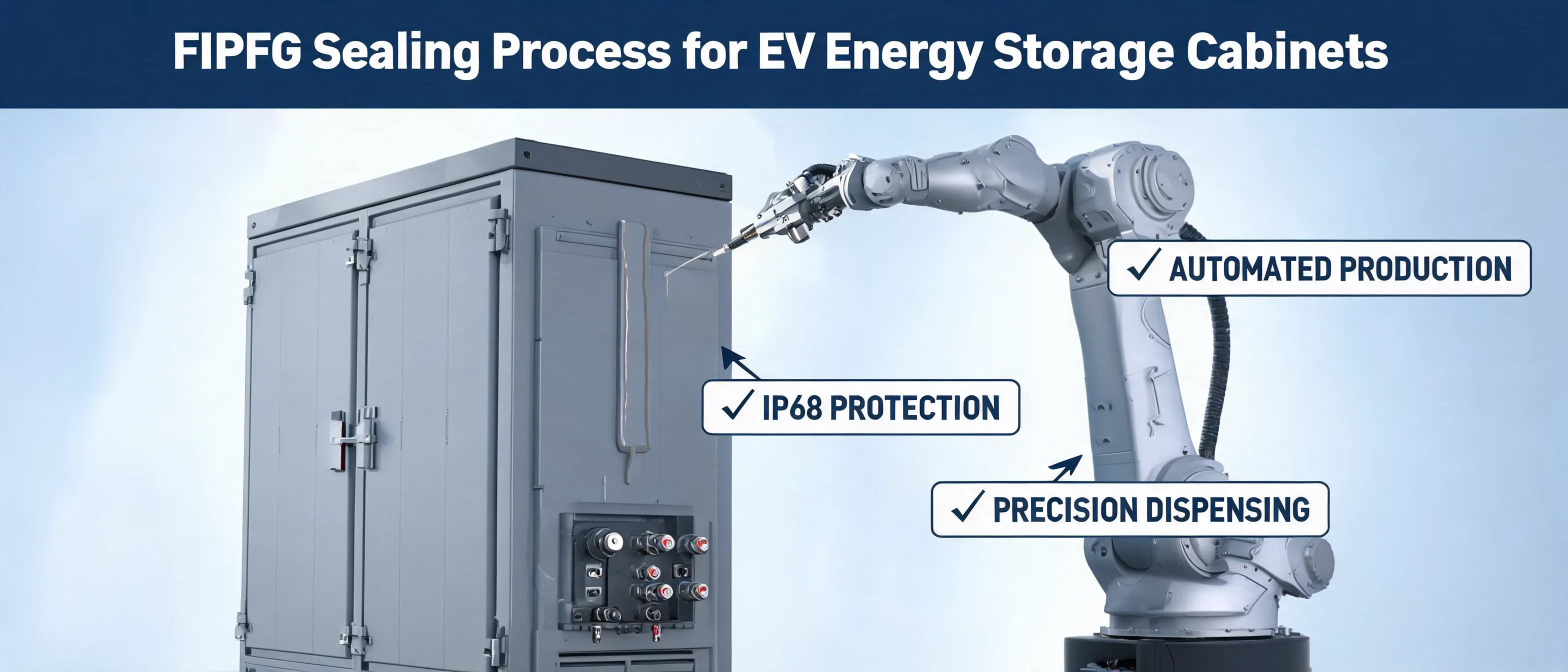
WINMAN WM-601 FIPFG on-site foaming gasket sealing machine is designed for demanding applications such as new energy vehicle Battery Packs, energy storage cabinets, and industrial electrical enclosures. It adopts a two-component material formed-in-place foamed gasket (FIPFG) process to achieve a continuous and consistent sealing bead path, with dispensing accuracy up to ±0.05 mm, meeting IP68 waterproof and dustproof requirements. The machine supports dual-station automated production, path programming, and remote diagnostics and maintenance, and is equipped with a high-efficiency cleaning system, significantly improving line efficiency and reducing labor and maintenance costs. Combined with the industrial-grade stability of the German Sonderhoff control system and compliance assurances such as ISO9001 and CE, WM-601 provides EV OEMs, battery PACK assembly plants, and Tier 1 suppliers with a reliable sealing automation solution, improving product safety and service life.
FIPFG Formed-In-Place Foamed Gasket Sealing Solution | Meeting High-Grade Sealing Needs for NEV Battery Packs & Energy Storage Cabinets
WINMAN WM-601 FIPFG Formed-In-Place Foaming Sealing Machine: Making Battery Pack Sealing More Stable, More Controllable, and Easier to Mass Produce
WINMAN WM-601 is an automatic FIPFG (Formed-In-Place Foam Gasket) dispensing/foaming sealing system developed and manufactured by Shanghai Winman Industrial Co., Ltd., designed for demanding applications such as new energy vehicle (NEV) battery packs (Battery Pack), energy storage cabinets (Energy Storage Cabinet), and industrial electronic enclosures, delivering replicable and traceable sealing process capability.
Under stable operating conditions, the system can achieve a ±0.05 mm dispensing accuracy (reference value; dependent on material viscosity/path curvature/fixture positioning), and provides a process foundation to support sealing designs targeting near IP68—minimizing variation within a production-acceptable range amid “thinner boundaries, more complex contours, and higher takt times.”
Why Are More Battery Packs and Energy Storage Cabinets Choosing FIPFG Sealing Instead of Traditional Sealing Strips?
In overseas customers’ search context, battery pack sealing often comes with keywords like “IP67/IP68 sealing for battery pack”, “foam gasket dispensing machine”, and “FIPFG sealing solution”. The common driver is that structures are becoming more complex, housing tolerances and assembly variation objectively exist, while products must endure vibration, temperature swings, dust, and condensation moisture over the long term.
The value of FIPFG is turning the “seal” from a prefabricated part into an “in-place formed process result,” making the sealing path programmable and repeatable—especially suitable for complex contours such as battery pack lids, housings, service ports, harness pass-throughs, and BMS/ECU enclosures.
Common Advantages of FIPFG (Based on Real Pain Points in Overseas Plants)
No tooling required: Design iterations are not constrained by mold lead time; smoother transition from prototype to mass production
Fits complex contours: Corners, arcs, local widening, hole avoidance paths can be called with one click
Higher consistency: Automated dispensing reduces human variation, lowering rework and leakage complaints
Stable sealing performance: Foaming forms a continuous sealing ring, reducing risks introduced by splices
Easier traceability: Can record ratio, flow, trajectory, batches (depending on configuration and MES integration)
WM-601 Core Performance: Breaking “Sealing Reliability” into Verifiable Parameters
Sealing for battery packs and energy storage cabinets is not just “able to dispense,” but being able to stay consistent across batches, shifts, and ambient temperatures as much as possible. WM-601 improves controllability at the equipment level through motion control, metering & mixing, process window management, cleaning & maintenance, and more.
Specification / Module
Reference Capability
Meaning for Battery Packs / Energy Storage Cabinets
Dispensing accuracy
±0.05 mm (reference value)
Reduces bead width/height variation, lowering local weak points and leakage risk
Operating speed
0–300 mm/s adjustable
Balances takt time and stability at corners/fine beads; fits different sealing paths
Dual-station design
Parallel operation, alternating loading/unloading
Improves throughput with the same manpower; can reduce labor input by 40%–60% (depending on takt and layout)
Control system
Industrial-grade control platform (optionally integrated with German Sonderhoff-related solutions)
More stable operation and clearer alarms; beneficial for standardized replication across global plants
Remote diagnostics
Supports remote maintenance/parameter assistance (subject to network and permissions)
Shortens downtime handling, especially for overseas delivery projects and long-term service
Cleaning & maintenance
High-pressure water/air cleaning, reducing residue and clogging
Reduces maintenance frequency and manual intervention; reduces dispensing defects due to insufficient cleaning
Key to Targeting IP68: Not Only “Equipment Accuracy,” but a “Process Closed Loop”
When evaluating an “IP68 sealing solution,” overseas customers often ask very specific questions: What is the foamed gasket height after foaming? What is the compression ratio? Can it absorb housing tolerance variation? Will rebound be insufficient after thermal cycling? Therefore, WM-601 emphasizes breaking IP rating goals into actionable process points.
1) More controllable gasket geometry
Reference for common battery pack lids: bead width 3–8 mm, height after foaming 2–6 mm (depending on structure and compression). Stable width/height helps control compression ratio and reduces local over-compression or insufficiency.
2) One-pass forming for complex contours
For corners, hole avoidance, and locally thickened sections, FIPFG paths are programmable, reducing “break points/splices” and lowering the probability of leakage paths—especially suitable for perimeter sealing of energy storage cabinet doors and electrical enclosures.
3) Easier standardized validation
With parameterized management of ratio, flow, path, and takt time, it is easier to establish internal CP/CPK and incoming/process audit logic; more friendly for cross-plant replication and supplier audits.
Typical Applications: From Battery PACKs to Industrial Control Cabinets—One Machine Covers Multiple Product Lines
WM-601 is commonly used for products that “need water/dust protection, need complex structural sealing, and need batch consistency.” For a foreign trade website solution page, clearly describing applications can significantly improve inquiry conversion quality, because customers can quickly judge “is this the machine I need.”
NEV Battery Module / Battery Pack (Battery Pack)
Lid-to-housing gasket, service ports, harness pass-through sealing, local dust/water sealing, etc. Suitable for projects with higher IP67/IP68 targets and stronger consistency requirements.
Energy Storage Cabinet / Energy Storage Container (Energy Storage)
Door perimeter sealing, compartment interface sealing, electrical enclosure sealing. For outdoor rain, wind-blown sand, and temperature swing environments, emphasizing long-term reliability and ease of maintenance.
ECU / BMS Enclosures
Suitable for small housings, complex curves, and multi-hole structures; improves yield through controllable dispensing, reducing rework caused by poor sealing.
Industrial Electrical Enclosures & Control Cabinets
More common in scenarios sensitive to dust and condensation moisture; FIPFG can reduce issues such as wrinkles, joints, and detachment found in manual gasket strip application.
What Overseas Projects Care More About: Delivery, Compliance, and “Can It Run Long-Term?”
Customers buying equipment for export usually don’t just buy a machine; they buy a set of capabilities that can be implemented—from voltage adaptation and operator training to spare parts and remote support. WM-601 is designed with a “long-term stable line operation” approach, making it easier to deliver projects in Europe, Southeast Asia, the Middle East, and other markets.
Certifications & Quality System (Compliance)
Certified to ISO 9001 quality management system (subject to the latest certificate)
Supports CE-compliant delivery to meet market access requirements for most European markets (subject to delivery list and nameplate)
Export projects can be supported with equipment documentation: manuals, maintenance guides, key parts lists, etc.
Common Global Delivery Configuration Requests (Customizable)
Voltage & electrical standard adaptation: reference support for 220V/380V, 50/60Hz (per project confirmation)
Multi-language HMI and training materials (provided per project)
Line integration: fixture positioning, takt assessment, loading/unloading method recommendations
Common Selection Questions (FAQ): Make Inquiries More Efficient and Solutions More Reliable
Can WM-601 achieve IP68? What else does the customer need to do?
An IP rating is a system-level result for the complete pack/cabinet, not determined only by the dispensing machine, but also by the material system, structural compression, housing flatness, assembly torque, etc. WM-601 provides high-consistency FIPFG forming capability to establish a process foundation for approaching an IP68 target. It is recommended to test with samples for water/dust performance and establish the corresponding process window (temperature/humidity, ratio, flow, path speed, curing time).
How much capacity increase can dual stations bring?
Typically, dual stations reduce idle time by running “dispensing and loading/unloading in parallel.” Taking a common perimeter sealing path as an example, if single-piece dispensing time is about 60–120 seconds, dual stations can often increase output by 30%–80% without adding headcount (depending on loading/unloading, leveling/curing wait, and whether vision positioning is required).
What foaming/sealing materials is the machine suitable for?
Common FIPFG materials include two-component PU foamed sealing materials, etc. Specific compatibility needs to be evaluated based on viscosity, pot life, target foaming ratio, and ambient temperature. We typically recommend customers provide the material datasheet and sample structure, verify the path and process window first, and then confirm the final configuration.
If the customer’s housing tolerance varies a lot, does FIPFG still have advantages?
When tolerance variation is large, traditional prefabricated gasket strips are more likely to have local under-compression or over-compression. With adjustable bead width/height and local thickening strategies, FIPFG is often easier to “absorb variation.” However, final performance still requires a system evaluation with the structural design (compression, rabbet/stop features, bolt spacing, etc.).
Want to turn battery pack/energy storage cabinet sealing from “experience-based” into a standardized, mass-producible process?
Send your product structure (2D/3D), sealing path sketch, target IP rating, and takt-time requirements. Based on WM-601, we can evaluate: recommended equipment configuration, takt-time estimation, material and foaming width/height references, and fixture positioning solutions. We also provide video demonstrations and test ideas to help you accelerate selection and project approval.